
Russian, Finnish, Turkish: What’s the Difference?
When you first hear Russian, Finnish and Turkish, the differences leap out immediately: the rolling consonants of Russian, the lilting vowels of Finnish, the steady cadence of Turkish. Yet beneath that audible contrast lie deeper structural, historical and cultural divergences that shape how speakers think, talk and write. This article walks you through those differences in plain language—grammar, sounds, writing systems, history, everyday usage, and practical tips for learners—so you can understand not just how these languages sound different, but why they are different.
Broad families and historical roots
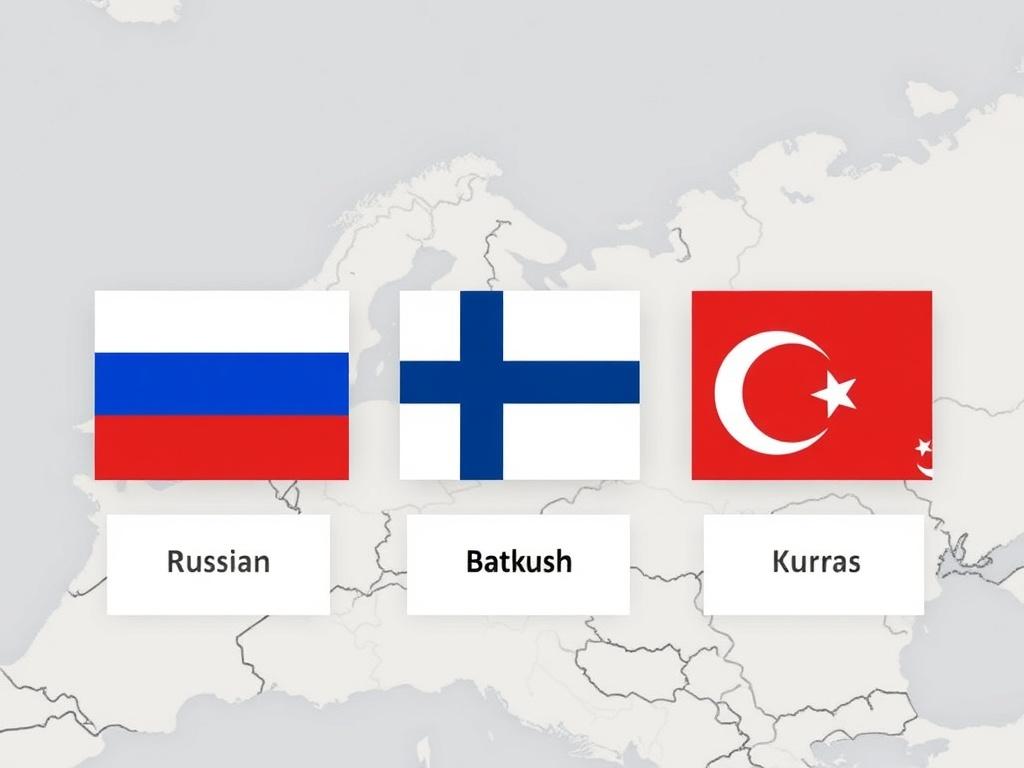
At the most basic level, Russian, Finnish and Turkish come from three distinct language families with separate origins. Russian is an East Slavic language in the Indo-European family, related to Ukrainian and Belarusian. Finnish belongs to the Uralic family, sharing roots with Estonian and more distantly with Hungarian. Turkish is a member of the Turkic family, related to Azerbaijani, Kazakh and other Central Asian languages.
These family ties explain why Russian, Finnish and Turkish don’t sound or feel remotely mutually intelligible. They also point to different historical influences: Russian absorbed Church Slavonic religious vocabulary and later French and German cultural words; Finnish was shaped by centuries of contact with Swedish and later Russian administration; Turkish bears the imprint of Ottoman-era Arabic and Persian, followed by 20th-century reforms that pushed native Turkic vocabulary and Western loanwords into everyday use.
Writing systems and orthography
How a language writes itself matters for learners and for how it preserves sounds. Russian uses the Cyrillic alphabet, introduced for Slavic peoples in the Middle Ages and adapted for modern Russian. Finnish and Turkish both use the Latin alphabet, but with different additional letters to capture sounds absent in English.
- Russian alphabet: 33 letters (Cyrillic). Distinguishes hard and soft consonants and maps fairly consistently to pronunciation except for unstressed vowel reduction.
- Finnish alphabet: Latin base plus characters like ä and ö. Finnish orthography is highly phonemic—what you see is almost always what you say.
- Turkish alphabet: Latin with letters such as ç, ğ, ı (dotless i), ö, ş, ü. Modern Turkish orthography was standardized in the 1920s and reflects vowel harmony rules.
The result: Turkish and Finnish learners can usually read aloud accurately after learning the alphabet, while Russian readers must also learn stress patterns and vowel reduction to pronounce words naturally.
Quick orthography comparison
| Feature | Russian | Finnish | Turkish |
|---|---|---|---|
| Alphabet | Cyrillic, 33 letters | Latin, 29 letters (incl. ä, ö) | Latin, 29 letters (incl. ç, ğ, ı, ö, ş, ü) |
| Phonemic spelling | Partly phonemic; vowel reduction complicates it | Highly phonemic | Highly phonemic and regular |
| Orthographic reforms | Relatively stable since 1918 | Little change in modern era | Major reform in 1928 (Arabic to Latin) |
Sound systems: vowels, consonants and rhythm
Phonology—the inventory of sounds and how they behave—divides the three languages into different sonic worlds. Vowel quantity and harmony, consonant palatalization, and stress placement are good starting points.
Vowels and vowel harmony
Finnish and Turkish both use vowel harmony, though it works differently in each language. Vowel harmony means that certain vowels attract suffixes that match them in front/back quality or rounding. Finnish divides vowels into front (ä, ö, y) and back (a, o, u) groups and generally prevents mixing within a single native word. Turkish has front/back and rounded/unrounded harmony, and its suffixes change according to the last vowel of the root.
Russian, by contrast, does not use vowel harmony. Russian vowels reduce in unstressed positions: the vowel ‘o’ often becomes [a] in casual speech, and unstressed vowels can lose clarity. That reduction is one reason Russian pronunciation sounds compacted compared with the open-vowel clarity of Finnish and Turkish.
Consonants and palatalization
Russian has a salient phonemic distinction between “hard” and “soft” consonants—palatalized versus non-palatalized sounds—which alters meaning (for example, “бес” vs. “бесь” would contrast if the latter existed). This palatalization system is central to Russian pronunciation.
Finnish lacks palatalization as a phoneme but features consonant gradation, where single vs. geminate consonants alternate in certain morphological contexts (e.g., “talo” vs. “talon”). Turkish consonants are straightforward; however, Turkish has sounds like the soft g (ğ) which lengthens the preceding vowel or creates subtle glide effects rather than a distinct consonant sound in modern pronunciation.
Stress and rhythm
Stress behaves differently across the three. Finnish stress is predictably on the first syllable of native words, giving Finnish a steady rhythm. Turkish stress tends to fall on the final syllable of words, but there are many exceptions based on morphology and borrowed words. Russian stress is mobile and unpredictable: it can fall on any syllable, and alternating stress can occur across related word forms. That unpredictability introduces an extra layer for learners: stress must often be memorized with the word.
Grammar at a glance: cases, agglutination, and word order
Grammar is where these languages show their most striking contrasts. Russian is an inflectional (fusional) language with a moderate-to-large case system. Finnish and Turkish are agglutinative: they append a sequence of suffixes to express grammatical relations.
Cases and how they mark grammatical roles
All three languages use cases rather than relying on articles and strict word order, but they do so in different ways.
- Russian: Six primary cases (nominative, genitive, dative, accusative, instrumental, prepositional) with endings that change by gender and number. Case endings fuse information—case, number and often gender are packed into a single ending.
- Finnish: Around 15 cases if you count local cases and marginal forms; cases mark locative relations extensively (inessive ‘in’, elative ‘out of’, illative ‘into’, adessive ‘on/at’, ablative ‘from on’, allative ‘onto’, etc.).
- Turkish: A smaller case inventory (nominative, accusative, dative, locative, ablative, genitive) but used with agglutinative suffixes that follow vowel harmony.
Because Finnish and Turkish are agglutinative, you often see long words piling up suffixes that might translate into a preposition + noun phrase in English. Russian achieves similar relationships through inflectional endings and prepositions.
Agglutination vs. fusional morphology
Think of agglutination as LEGO: each suffix is a clearly separable piece that adds one function. Turkish and Finnish build words by stacking these pieces in a regular order. Russian is more like a molded sculpture: changes to the stem and ending often combine several grammatical meanings in a fused way, so endings are less separable visually and analytically.
Verb systems and aspects
Verbs also follow distinct patterns. Russian verbs encode aspect (perfective vs. imperfective) as a core lexical category—choosing the right aspectual pair is essential for conveying whether an action is completed, repeated or ongoing. Finnish verbs have fewer aspectual contrasts and rely more on context and auxiliary constructions. Turkish marks aspect and tense with suffixes and employs auxiliary verbs for progressive or nuance, but generally its temporal system is quite regular and predictable thanks to agglutinative morphology and vowel harmony.
Word order and flexibility
All three languages allow some flexibility in word order because morphology marks roles, but preferences differ. Russian typically uses SVO in neutral sentences but permutes elements for emphasis or topicalization. Finnish likewise tends toward SVO, with information structure driving permutations, and keeps the main stress early. Turkish is often described as SOV (subject-object-verb) in neutral ordering, but in practice it can vary with topicalization and focus markers.
Pronouns, articles and definiteness
One neat similarity: none of these languages has a direct equivalent of the English indefinite article “a.” Definiteness is handled differently, though.
- Russian: No articles. Definiteness is usually inferred from context and word order; demonstratives and stress can add specificity.
- Finnish: No articles. Definiteness can be signaled with possessive suffixes, demonstratives, or pragmatics. Word order and case also help clarify reference.
- Turkish: No separate indefinite article, but the accusative case marks definite direct objects. Turkish uses suffixes and particles to express specificity and definiteness rather than standalone articles.
Pronouns follow each language’s morphosyntactic patterns. Turkish uses agglutinative possessive suffixes to indicate possession directly on the noun (“evim” = my house). Finnish uses possessive suffixes too, while Russian typically uses a genitive construction with a possessive pronoun or a possessive adjective.
Vocabulary, loanwords and mutual influence
Vocabularies reflect history. Russian vocabulary has deep Slavic roots and large numbers of loanwords from Old Church Slavonic, French, German and English. Finnish vocabulary preserves Uralic roots but borrows heavily from Swedish and Russian; in modern Finnish you’ll find many international loanwords. Turkish vocabulary was dramatically reformed in the early 20th century: the language academy promoted native Turkic words and replaced many Arabic and Persian loanwords, while also borrowing from European languages.
The three languages also show different strategies for creating new words: Finnish and Turkish freely coin agglutinative compounds or use productive suffixes, while Russian often creates derivatives through inflectional and derivational suffixes or adopts foreign roots with Russianized endings.
Examples of loanword influence
| Source of loans | Russian examples | Finnish examples | Turkish examples |
|---|---|---|---|
| French/German/English | бюро (buro), проект (proekt), компьютер (kompyuter) | kompuutteri (computer), historia, pankki (bank from Swedish) | televizyon (television), restoran (restaurant) |
| Swedish/Russian influence | — | kunta (municipality from Swedish kunta? note: administrative terms from Swedish), raja (border) | — |
| Arabic/Persian (historical) | — | — | kitap (book from Arabic/Farsi kitab), divan (council) |
Dialects and regional variation
Within each language, accents and dialects shape pronunciation and vocabulary. Russian dialects range across the vast territory of Russia—northern, southern and central varieties with different vowel qualities and intonation patterns. Standard Russian is based on the Moscow dialect and literary norms.
Finnish dialects vary significantly, particularly between eastern and western dialects. Some dialects maintain archaic features and differences in vowel length, consonant gradation and intonation; nevertheless, the national media and education system promote a standard Finnish (yleiskieli) that is widely understood.
Turkish dialects include Istanbul/Turkish Standard, Aegean coastal dialects, Eastern Anatolian varieties and numerous rural forms. Kurdish, Arabic and other minority languages in Turkey also influence local Turkish dialects. The standard is based largely on Istanbul speech and the modern literary tradition.
Politeness, formality and address
Social language differs across cultures. Russian uses the familiar ty (ты) and formal vy (вы) pronouns to mark relationships and respect—choosing between them is socially meaningful. Finnish historically had distinctions between polite forms and more colloquial speech but relies less on a formal pronoun pair; modern Finnish tends to use singular ‘sinä’ for you in most contexts, with politeness expressed through tone and lexical choices. Turkish has a polite form of address as well—’siz’ is plural/polite ‘you’ while ‘sen’ is singular familiar ‘you’—and like Russian the choice signals social distance.
In workplaces and formal situations, all three languages have registers and lexical markers to signal respect, but the mechanics differ: pronoun choice in Russian and Turkish; lexical and tone choices in Finnish.
Everyday usage: media, signage and multilingual contexts
How you encounter these languages in the wild varies. In Russia, you’ll find Cyrillic on signs, menus and government documents; many Russians also speak English in urban centres, but regional areas may rely on Russian-only signage. In Finland, signage is typically bilingual Finnish–Swedish in many regions; official documents may appear in both. Turkey uses Latin script and displays a clear modernization in public signage; in tourist areas English is often visible as well.
Multilingualism patterns differ: bilingualism in Russian-speaking republics (e.g., Tatarstan) is common; in Finland many people are bilingual in Finnish and Swedish and often know English; in Turkey, regional bilingualism occurs where other languages like Kurdish are prevalent, and younger generations increasingly learn English.
Learning difficulty: what’s easier or harder for an English speaker?
If you speak English, which of these languages is “easiest”? There’s no single answer—each has tough spots and helpful patterns.
- Russian: Learning the Cyrillic alphabet is straightforward. The main difficulties are unpredictable stress, vowel reduction, complex case endings, aspectual verb pairs and irregularities. Pronunciation requires attention to palatalization. Grammar can feel less regular than in agglutinative languages.
- Finnish: The orthography is friendly and predictable. The heavy lift is the case system (multiple locative cases) and long compound words; consonant gradation and vowel harmony add rules to master. Once the rules are understood, they apply consistently.
- Turkish: Regular rules and vowel harmony make morphology logical. Turkish verbs and suffix ordering are systematic. The challenge can be learning to parse long strings of suffixes and getting used to vowel harmony and the dotless/dotted i distinction in writing and pronunciation.
From a purely procedural perspective, many learners find Turkish and Finnish easier to produce grammatically correct sentences early on because rules are regular and exceptions are fewer. Russian tends to require memorization of irregular patterns. But motivation, exposure and learning strategy matter more than theoretical difficulty.
Practical learning tips for each language
- Russian: Learn Cyrillic thoroughly and practice listening to unstressed vowel reduction. Study aspect pairs early and drill case endings with real sentences rather than isolated paradigms. Use graded readers and news podcasts for comprehensible input.
- Finnish: Memorize the core set of cases and learn the rules of vowel harmony and consonant gradation. Start forming simple inflected phrases (e.g., “talossa” = in the house) and use flashcards for case endings tied to contexts. Listening to children’s media helps with steady rhythm and vowel clarity.
- Turkish: Master vowel harmony and the order of suffixes (root + tense/aspect + person + possessive). Build parsing skills by breaking down long words into suffix chains. Shadow native speech to internalize the cadence and final stress tendencies.
Culture, literature and idiomatic expression
Language and culture are interwoven. Russian literature—from Pushkin and Dostoevsky to contemporary writers—shapes idiomatic expressions and high-register written norms. Finnish literature and folk tradition emphasize nature, seasonal life and concise metaphors; writers like Elias Lönnrot and modern poets have crystallized a distinct voice. Turkish literature ranges from Ottoman divan poetry to modern realist novels; the language reforms of the 20th century created a new national literary voice accessible to wider audiences.
Idioms and proverbs in each language reflect worldview and social priorities. Russian proverbs often invoke collective wisdom or historical perspective. Finnish sayings highlight stoicism, the natural world and understatement. Turkish idioms frequently draw on Ottoman-era references and everyday practical metaphors.
Sample sentences and structural contrasts
Seeing similar meanings expressed in all three languages makes contrasts concrete. Below are simple examples that show how the same idea looks different morphologically and syntactically. For clarity, translations are approximate.
| English | Russian | Finnish | Turkish |
|---|---|---|---|
| I saw the woman in the house. | Я видел женщину в доме. (Ya videl zhenshchinu v dome.) | Näin naisen talossa. (Näin naisen talossa.) | Evi̇nde kadını gördüm. (Ev-in-de kadın-ı gördüm.) |
| My friend’s book | Книга моего друга (Kniga moyego druga) | Ystäväni kirja (friend-my book) | Arkadaşımın kitabı (friend-my-GEN book-POSS) |
| I will go to the city tomorrow. | Завтра я поеду в город. (Zavtra ya poedu v gorod.) | Huomenna menen kaupunkiin. (Huomenna menen kaupunki-in.) | Yarın şehre gideceğim. (Yarın şehir-e gideceğim.) |
Note how Finnish and Turkish use case endings on the noun for “in the house” or “to the city,” while Russian uses a preposition plus a case-marked noun. Possession is often expressed by suffixes in Finnish and Turkish, while Russian uses a genitive construction.
Common learner pitfalls and how to avoid them
Every language has traps for learners. Identifying common errors helps you avoid them.
- Russian: Over-reliance on direct English equivalents. Russian verbs of motion and aspect require separate study; don’t assume one verb matches several English uses. Watch unstressed vowel reduction in spoken practice to avoid fossilized mispronunciation.
- Finnish: Ignoring vowel harmony and consonant gradation early leads to repeated mistakes. Learn case uses in context rather than rote lists—pair cases with typical verbs and prepositions.
- Turkish: Mishandling vowel harmony is the most frequent mistake. Also, learners sometimes try to apply English word order and forget to attach the correct suffixes for tense and person. Practice breaking down multi-suffix words into parts to improve comprehension.
Where these languages matter today: demographics and geopolitics
Russian remains a major language across Eurasia with over 150 million native speakers and a broad role as a lingua franca in former Soviet states. Finnish is the primary language of Finland (around 5 million native speakers) with official minority provision for Swedish. Turkish has around 80 million native speakers and a significant diaspora in Europe and the Middle East, making it geopolitically and culturally influential in its region.
Each language’s role affects access to media, literature and language-learning resources. Russian-language content abounds across news, literature and scientific publishing. Finnish media is smaller but high-quality, with strong public broadcasting and digital resources. Turkish media and entertainment—television dramas, music and cinema—have a large international reach, especially across the Middle East and parts of Europe.
Digital age and technology: keyboards, typing and online resources
Typing in these languages uses different keyboard layouts: Russian uses a Cyrillic keyboard, Finnish uses a standard QWERTY with easy access to ä and ö, and Turkish keyboards include keys for ç, ğ, ı, ö, ş, ü. Many operating systems support switching layouts easily. For learners, apps, online courses and massive open resources exist in abundance—Duolingo supports Russian, Finnish and Turkish; major online universities and language platforms offer structured lessons; YouTube and podcasts supply free listening practice.
Machine translation quality varies: Russian-to-English translations are relatively mature, while Finnish and Turkish can pose challenges for MT because of agglutinative morphology, though quality has improved. For writing and grammar support, language-specific tools and community forums are often more reliable than automated translators for nuanced texts.
Which language should you learn? practical considerations
The choice depends on your goals. Consider these pragmatic factors:
- Purpose: Travel, family, work, literature, academic research—each pushes you toward a different language.
- Availability of resources: Russian and Turkish have abundant materials and communities; Finnish resources are excellent but smaller in scale.
- Cultural interest: If you love Nordic design and quiet nature writing, Finnish fits. If you’re drawn to Eurasian geopolitics and classical literature, Russian rewards you. If you enjoy vibrant modern pop culture and regional connections, Turkish offers access.
- Time and learning style: If you prefer clear, regular rules, Turkish or Finnish might suit you; if you enjoy navigating irregularities and learning via rich literary culture, Russian can be engaging.
Short decision guide
| Interest | Recommended language |
|---|---|
| Business in Eastern Europe/Central Asia | Russian |
| Nordic culture, design, nature | Finnish |
| Turkey, Middle East, Ottoman history | Turkish |
| Systematic grammar and regular morphology | Turkish or Finnish |
Everyday phrases and a taste of terseness vs. lyrical speech
A few common phrases show tone and rhythm differences. Each line gives the expression, transliteration where helpful, and a translation.
- Russian: Спасибо (Spasibo) — Thank you. Short, clipped, polite.
- Finnish: Kiitos — Thank you. Minimal and regular; pronounced exactly as written.
- Turkish: Teşekkür ederim — Thank you (formal). Turkish often uses longer polite constructions but colloquial variants like “teşekkürler” are common.
These small phrases capture how each language balances formality and everyday interaction: Russian politeness often packs social nuance into pronouns and verb forms; Finnish keeps things economical; Turkish offers distinct polite phrasing anchored in conventional clauses.
Fun linguistic curiosities
Each language has features that delight linguists and learners alike. Russian has famously mobile stress that can change meaning across related forms. Finnish creates enormous compound words that read like tiny stories (e.g., “lentokonesuihkuturbiinimoottoriapuvaruste”—an extreme example of compounding in Germanic like English/German). Turkish words can accumulate many affixes to express complex nuances in a single, neat package.
Finnish panoply of locative cases provides precision for spatial descriptions—something English circumlocutes with prepositions. Turkish vowel harmony gives a musical logic to suffixes, making words feel like self-contained melodies. Russian’s palatalized consonants add a soft-sharp contrast that colors entire word classes.
Resources to start with
Beginner-friendly resources that are reliable:
- Russian: “The New Penguin Russian Course” for grammar, Russian news in slow speech, graded readers, and apps like LingQ and Memrise.
- Finnish: “Complete Finnish” (Teach Yourself), Yle’s children’s news (Yle Areena), and websites that explain case use with practical exercises.
- Turkish: “Teach Yourself Turkish” or “Elementary Turkish” for grammar, Turkish television series and podcasts for listening, and practice sites that break down vowel harmony with drills.
Language exchange communities and tutors accelerate progress. Immerse through media first for ear training, then consolidate with grammar-focused study and active production.
Final practical comparison table
| Feature | Russian | Finnish | Turkish |
|---|---|---|---|
| Language family | Slavic (Indo-European) | Uralic | Turkic |
| Script | Cyrillic | Latin (ä, ö) | Latin (ç, ğ, ı, ö, ş, ü) |
| Morphology | Fusional/inflexional | Agglutinative | Agglutinative |
| Cases | 6 major | ~15 | 6 |
| Vowel harmony | No | Yes (front/back) | Yes (front/back and rounding) |
| Stress | Mobile/unpredictable | Fixed (first syllable) | Tends to be final, variable |
| Articles | None | None | None (definiteness via accusative) |
| Typical word order | SVO (flexible) | SVO (flexible) | SOV (but flexible) |
Practical next steps if you want to try one
Decide on immediate goals—survival phrases for travel, conversational fluency, reading literature—and pick a starter method: an app plus a tutor, an intensive course, or a language exchange partner. Set weekly micro-goals (e.g., 20 minutes of listening a day, 10 new words a day, one grammar topic per week). For all three languages, speaking early—even imperfectly—is invaluable. Pronunciation habits form quickly, so practice out loud and seek corrective feedback.
Conclusion
Russian, Finnish and Turkish differ at every linguistic layer: their ancestral families, sound systems, writing systems, grammatical architecture and cultural histories. Russian’s inflectional complexity and unpredictable stress contrast with Finnish’s steady phonemic spelling and rich case system, while Turkish’s elegant agglutinative regularity and vowel-harmonious suffixes offer a third, distinct model. None of the three has a built-in advantage for every learner—each offers its own challenges and rewards—but all three open doors to rich literatures, histories and ways of thinking; if you choose one, follow curiosity, be systematic in study, and enjoy how learning a language reshapes not just your words but how you see the world.

